
How Long Should You Wait to Fly After Diving?
For many divers, especially when travelling for a diving holiday, the question often comes up:
“When is it safe to fly after diving?”
This topic isn’t only about following rules — it’s about understanding how your body processes nitrogen and avoiding the risk of decompression sickness (DCS). Let’s take a closer look at the official recommendations, the reasons behind them, and how we at Scuba Legends Lanzarote plan our diving schedules to make it all safe and simple for you.
Why Flying After Diving Is a Risk
When you dive, your body absorbs nitrogen from the breathing gas under pressure (e.g., air: 21% oxygen / 79% nitrogen). The deeper and longer you dive, the more nitrogen dissolves in your tissues. Whilst nitrogen is an inert gas your body does not actually “use” nor “need” it. During ascent, the nitrogen safely leaves your body through breathing — but only if the ascent and surface intervals are well-managed.
If you fly too soon after diving, the cabin pressure at altitude (usually equivalent to being at 2,000–2,400 meters above sea level), can cause nitrogen bubbles to expand too quickly. It can be compared to a rapid ascent when diving. In consequence, this can lead to decompression sickness, a serious and potentially life-threatening condition.
Official Guidelines: How Long Should You Wait Before Flying?
Different organizations have published recommendations, and they all align quite closely. The most widely accepted comes from DAN (Divers Alert Network).
We break it down by dive profile:
🧭 Single No-Decompression Dive
12+ hours minimum surface interval before flying.
If you only did one recreational dive in a day, your nitrogen load is relatively low, and a 12-hour waiting time is considered sufficient.
🧭 Two or More No-Decompression Dives
18+ hours minimum surface interval before flying.
When you complete two dives or more (e.g., multi day repetitive diving), your body needs a bit more time to off-gas the additional nitrogen.
🧭 Technical or Decompression Dives
24+ hours minimum surface interval before flying.
Technical dives or any dives involving mandatory decompression stops result in significantly higher nitrogen loads.
DAN and other organizations recommend at least 24 hours, though some divers and instructors prefer a full 36-hour gap before flying for added safety.
Why Your Dive Computer Shows 24h No-Fly Time?
Most dive computers display a fixed 24-hour no-fly time, even after a short shallow dive. They use conservative algorithms designed for maximum safety. A universal limit covers all types of dive profiles, body conditions, and future dives. The idea is reducing the risk of decompression sickness and altitude exposure. While DAN and others state that 12–18 hours is sufficient for recreational dives, dive computer manufacturers prefer a 24-hour buffer to ensure every diver stays on the safe side including their liability.
Can You Dive Directly After Flying?
Yes — there’s no risk in diving shortly after flying.
Upon arrival at your destination, your body is in a normal, de-saturated state. Flying does not increase nitrogen levels in your tissues, so there’s no need to wait before going for your first dive (as long as you’re rested and hydrated).
That’s why at Scuba Legends Dive Center Lanzarote, you can safely join a dive on your first day on the island — even right after arrival.
How Scuba Legends Plans Your Dives Safely
At Scuba Legends Lanzarote, we take dive safety and trip planning seriously.
Our double dive mornings finish by midday, giving you plenty of time to enjoy the rest of your day — and more importantly, ensuring a long surface interval before your flight home.
For example:
If you dive with us on the day before departure and your flight is the next morning after breakfast, you’ll typically enjoy 18+ hours of no-fly time, perfectly matching or exceeding the official safety guidelines.
So, there’s no need to skip diving on your last day in Lanzarote — as long as your flight schedule allows it, you can safely join our morning dives and still fly out with complete peace of mind.
Final Thoughts
Diving and flying a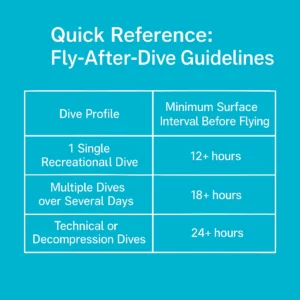 re both part of every great dive holiday — but knowing how to time them safely makes all the difference.
By understanding the principles of nitrogen off-gassing and respecting the recommended no-fly intervals, you’re ensuring your body’s safety and comfort.
At Scuba Legends Dive Center Lanzarote, we plan all our dives with this in mind — so you can enjoy every minute underwater, and still make your flight home with complete confidence.
Dive Safe. Dive Smart. Dive Legendary.